
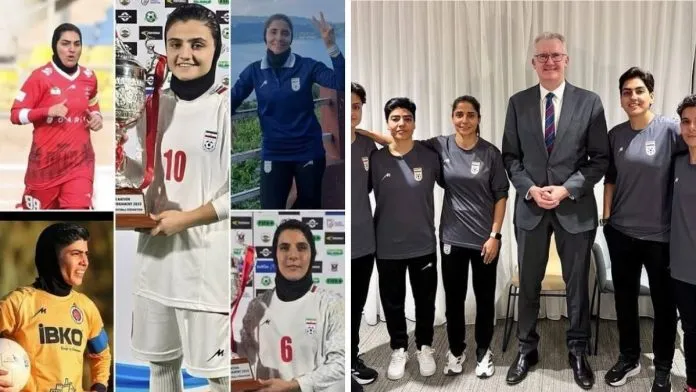
Five members of Iran’s national women’s football team have reportedly been granted humanitarian visas in Australia after a dramatic late-night operation following the team’s participation in the 2026 AFC Women’s Asian Cup.
The incident has drawn international attention and sparked political discussion involving senior leaders including Anthony Albanese and Donald Trump.

According to Australian officials, the five athletes sought protection after expressing fears of potential repercussions if they returned to Iran.
Their concerns reportedly stemmed from their refusal to sing the Iranian national anthem during an earlier match in the tournament—an act widely interpreted as a silent protest amid ongoing political tensions surrounding women’s rights in Iran.
The Iranian women’s national team had been staying on Australia’s Gold Coast during the tournament.


Reports suggest that after their final match, several players privately approached Australian officials seeking advice about their safety should they return home.

Late Monday evening, the five footballers—identified as captain Zahra Ghanbari along with Fatemeh Pasandideh, Zahra Sarbali, Atefeh Ramazanzadeh and Mona Hamoudi—were quietly escorted away from their hotel by Australian authorities.
The operation was reportedly coordinated with assistance from the Australian Federal Police to ensure the players could leave without drawing attention.
The athletes were then transported to a secure location in Brisbane, where they remain under protective arrangements while their immigration status is processed.
Australia’s Minister for Home Affairs explained that officials had been working for several days to ensure the players were aware of the options available to them under Australian law.

“Over recent days there has been a lot of work going on to ensure these women understood that they could seek assistance if they wished,” the minister told reporters.
“Once those discussions became formal, humanitarian visa applications were processed very quickly.”
Authorities confirmed that the visas were approved in the early hours of the morning after the players formally requested protection.
Officials present during the process described emotional scenes once the visas were granted.
The players reportedly celebrated the news together, with some supporters saying the athletes even joined in the famous Australian chant “Aussie, Aussie, Aussie, Oi, Oi, Oi.”
The phrase, widely used by Australian sports fans, quickly became symbolic of the moment on social media as supporters praised the country’s response.
Prime Minister Anthony Albanese later addressed the situation, saying Australians had been deeply moved by the players’ circumstances.
“These women are safe here,” Albanese said. “Australia believes in supporting those who seek help when they face serious risk.
We will continue to ensure their wellbeing while their situation is resolved.”

The case also drew attention overseas. Former U.S. president Donald Trump publicly urged Australia to protect the athletes, posting online that sending them back to Iran could place them in danger.
In a subsequent message, Trump said he had spoken with Prime Minister Albanese about the situation and praised Australia’s handling of what he described as a “delicate humanitarian matter.”
While political figures debated the issue online, Australian officials emphasized that decisions were based solely on humanitarian and legal considerations.
The incident highlights the complex relationship between sports, politics, and women’s rights in Iran.
Female athletes from the country have faced increasing scrutiny in recent years, particularly after the widespread protests that followed the death of Mahsa Amini in 2022.
Several Iranian athletes competing internationally have previously made symbolic gestures—such as refusing to sing the national anthem or wearing protest symbols—to express solidarity with demonstrators advocating for greater freedoms for women.

Human rights organizations say such acts can place athletes and their families at risk when they return home.
Because of these concerns, some Iranian sports figures have chosen to remain abroad after competitions, seeking asylum or alternative residency in other countries.
Outside the team’s Gold Coast hotel, groups of supporters reportedly gathered to show solidarity with the players during the unfolding situation. Despite heavy rain, many remained overnight holding banners and cheering for the athletes.
The strong public response reflects the growing global visibility of women’s football and the public support many athletes receive when they take stands on social or political issues.
The Iranian women’s team itself has gained significant international recognition in recent years as the sport continues to expand worldwide.
Australian authorities say the five players will remain under protective arrangements while their cases move through the country’s immigration system. Humanitarian visas can allow individuals to remain in Australia while longer-term residency or asylum claims are assessed.
Officials also confirmed that the same opportunity remains open to other members of the Iranian squad who may wish to seek assistance.
For now, the five players remain focused on their safety and future in the sport they love. Supporters hope the athletes will eventually be able to continue their football careers—whether in Australia or elsewhere—without fear of persecution.
The dramatic episode has become one of the most talked-about stories of the tournament, highlighting how international sport can intersect with broader human rights and political debates.