
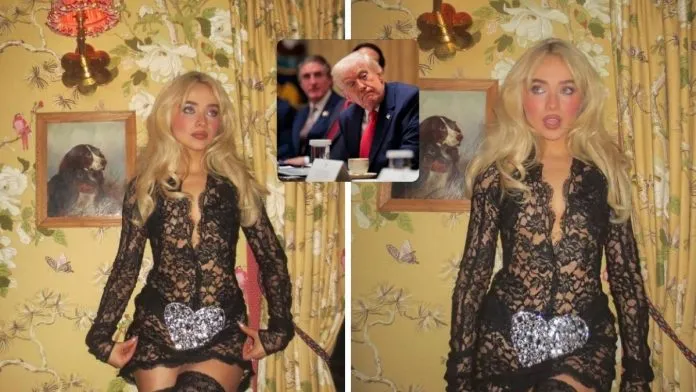
The White House is under fire after using pop star Sabrina Carpenter’s music in a video highlighting U.S. Immigration and Customs Enforcement (ICE) operations, prompting the singer to publicly condemn the move. Despite Carpenter’s criticism, officials have stated they will not issue an apology.

On Tuesday, the White House shared a video online featuring ICE agents making arrests, accompanied by Carpenter’s song Juno.
The 26-year-old singer quickly took to X (formerly Twitter) to express her disapproval, describing the video as “evil and disgusting” and condemning the use of her music to support what she called an “inhumane agenda.”
“Do not ever involve me or my music to benefit your inhumane agenda,” Carpenter wrote in a post that rapidly gained attention across social media platforms.
White House Responds to Carpenter’s Criticism
Rather than retracting the post, the White House doubled down. Spokesperson Abigail Jackson defended the video, framing the ICE operations as necessary for national security. “
Here’s a Short n’ Sweet message for Sabrina Carpenter: we won’t apologize for deporting dangerous criminal illegal murderers, rapists, and pedophiles from our country,” Jackson told Newsweek.

Jackson also referenced Carpenter’s own lyrics from her song Man Child, asking rhetorically, “Anyone who would defend these sick monsters must be stupid, or is it slow?”
The comment sparked further debate online about the intersection of celebrity influence, politics, and social media.
This is not the first time the White House has faced criticism for incorporating pop music into politically charged content. In July, British singer Jess Glynne publicly criticized the White House for using her hit Hold My Hand in a social media clip related to deportation.
That post, which juxtaposed her upbeat song with footage of individuals in handcuffs, quickly went viral, amassing over 12 million views.

Glynne reacted strongly, posting on Instagram that the video made her “sick,” emphasizing that her music promotes love, unity, and positivity—not division or hate.
Similarly, voiceover actress Zoe Lister, whose narration accompanied a promotional Jet2 clip repurposed in the ICE video, expressed outrage over the use of her voice for political messaging.

The trend has drawn the attention of several other high-profile artists, including ABBA, Bruce Springsteen, Olivia Rodrigo, Neil Young, Guns N’ Roses, Celine Dion, Rihanna, Phil Collins, Beyoncé, and Adele, all of whom have previously objected to their music being used by the White House without consent.
The controversy comes amid the Trump administration’s intensified focus on cracking down on illegal immigration.
Since taking office, the president has emphasized that ICE will target individuals allegedly involved in murder, drug trafficking, sex offenses, and terrorism.

New appointments within the agency have reinforced this approach, with officials responsible for tracking and deporting unauthorized residents across the United States.
While the administration frames these actions as enforcing the law and protecting public safety, critics argue that the tactics are inhumane and politically motivated.
The use of pop music in enforcement-related social media content has become a flashpoint, highlighting tensions between celebrity influence, public policy, and the digital age’s viral culture.
As social media reactions continue to unfold, the debate over the White House’s use of Carpenter’s song underscores the growing scrutiny over how government agencies engage with culture and media online.
For now, both Carpenter and the administration remain firm in their positions, leaving the controversy unresolved.